Showing posts with label Philippa Gregory. Show all posts

Wednesday, July 4, 2012

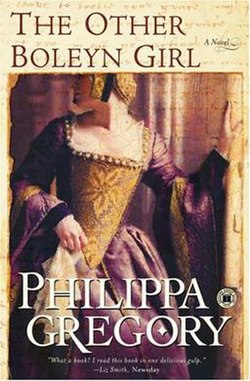
Book Review: The Other Boleyn Girl

When Mary Boleyn comes to court as an innocent girl of fourteen, she catches the eye of Henry VIII. Dazzled by the king, Mary falls in love with both her golden prince and her growing role as unofficial queen. However, she soon realizes just how much she is a pawn in her family's ambitious plots as the king's interest begins to wane and she is forced to step aside for her best friend and rival: her sister, Anne. Then Mary knows that she must defy her family and her king, and take her fate into her own hands.

A rich and compelling tale of love, sex, ambition, and intrigue, The Other Boleyn Girl introduces a woman of extraordinary determination and desire who lived at the heart of the most exciting and glamorous court in Europe and survived by following her own heart.


When one thinks of Tudor England, he thinks of The Other Boleyn Girl. It's unfortunate, but true. Now, I've written a whole article disproving several highly fictional points of this novel, and so repeating all the wretched depictions I hated about this book would be awfully irksome and repetitive. There are many points I made here in my article "Breaking Down 'The Other Boleyn Girl'" that, if you're considering reading this should definitely read first before this review and before the actual novel.

Now to begin the actual review. With a story like Anne's and Mary's, there was so much potential for a great novel. And Gregory did create a great novel: just not a historical one. The Other Boleyn Girl was a rotten blend of lies and twisted truth, and it is a real shame that it represents Tudor books and has destroyed Anne Boleyn's reputation. All history grudge's aside, it's an entertaining book, but there should be a warning label so that readers can know just how fictional the novel is. Aside from history and plot, Gregory's writing style is laid-back yet sensory, rich and yet stylishly dry. Sure, I hated this book but there's no denying that she's one of the most talented writers out there. I don't recommend the novel, but as long as you're aware of the truth, go ahead and take a try at it, but warning, your blood will boil.

Statistics
Pages: 672
Publisher: Touchstone
Year Published: 2001
Kylie's Rating: ♛/♛♛♛♛♛ (1/5 Stars)

Book Review: The Boleyn Inheritance

Three Women Who Share One Fate: The Boleyn Inheritance
Anne of Cleves: She runs from her tiny country, her hateful mother, and her abusive brother to a throne whose last three occupants are dead. King Henry VIII, her new husband, instantly dislikes her. Without friends, family, or even an understanding of the language being spoken around her, she must literally save her neck in a court ruled by a deadly game of politics and the terror of an unpredictable and vengeful king. Her Boleyn Inheritance: accusations and false witnesses.

Katherine Howard: She catches the king's eye within moments of arriving at court, setting in motion the dreadful machine of politics, intrigue, and treason that she does not understand. She only knows that she is beautiful, that men desire her, that she is young and in love -- but not with the diseased old man who made her queen, beds her night after night, and killed her cousin Anne. Her Boleyn Inheritance: the threat of the axe.


Jane Rochford: She is the Boleyn girl whose testimony sent her husband and sister-in-law to their deaths. She is the trusted friend of two threatened queens, the perfectly loyal spy for her uncle, the Duke of Norfolk, and a canny survivor in the murderous court of a most dangerous king. Throughout Europe, her name is a byword for malice, jealousy, and twisted lust. Her Boleyn Inheritance: a fortune and a title, in exchange for her soul.

The Boleyn Inheritance is a novel drawn tight as a lute string about a court ruled by the gallows and three women whose positions brought them wealth, admiration, and power as well as deceit, betrayal, and terror. Once again, Philippa Gregory has brought a vanished world to life -- the whisper of a silk skirt on a stone stair, the yellow glow of candlelight illuminating a hastily written note, the murmurs of the crowd gathering on Tower Green below the newly built scaffold. In The Boleyn Inheritance Gregory is at her intelligent and page-turning best.


For someone who prides herself as an avid reader of Tudor fiction, the only novels I really ever read were related to Anne Boleyn or her daughter Elizabeth. This was my first try at reading of Henry VIII's fourth and fifth queens, Anne of Cleves and Katherine Howard, and Anne's notoriously 'crazy' sister-in-law, Jane Rochford. Out of the gate what I enjoyed was how Gregory tied in constantly references to Anne's story, memories of her, as though she's watching it all and is still a part of the story, hence the title. So much has changed in this novel since The Other Boleyn Girl, a.k.a. the times of Anne Boleyn and yet so much has remained the same; court-life is as glamorous and fun to read about as ever, and Anne stands practically a ghost giving depth, life, and excitement to The Boleyn Inheritance.

What I did not enjoy about the novel was its speed; it moved far too quickly. Anne of Cleves arrives in England, and after that it's a blur. She's cast aside and there are good as no events of her 'reign' given. Henry VIII too soon falls in love with Katherine Howard, if you could even call it love, and in the blink of the eye they're married. It's difficult for one to believe that the story was rushed being 518 pages; however there was just not enough of Katherine's almost two-year reign, nor was there enough regarding her dramatic fall. I also disliked how after her marriage to Henry is annulled, Anne of Cleves good as disappears from the story, or whatever happens in her point-of-view chapters are insignificant. I feel as though her character is needed only briefly at the beginning when she is Queen and briefly at the end, to show what the people outside of court are hearing about Katherine Howard, and to give some sort of epilogue of how the rest of Henry VIII's life went. If this was the last of Gregory's Henry VIII related novels, I think she could have expanded on Catherine Parr's own 'Boleyn inheritance'.

I definitely had my issues with The Boleyn Inheritance but there is no denying that Gregory's writing is tasteful and engaging as ever and her talents at bringing together history and romance continue to shine. I can't say that I would recommend this as a necessary Tudor read, but it's a fun adventure through Henry VIII's wives, court, and times and a novel worth reading.

Statistics
Pages: 518
Publisher: Touchstone
Year Published: 2006
Kylie's Rating: ♛♛♛/♛♛♛♛♛ (3/5 Stars)
Book Review: The Virgin's Lover

As a new queen, Elizabeth faces two great dangers: the French invasion of Scotland, which threatens to put Mary Queen of Scots on her throne, and her passion for the convicted traitor Robert Dudley.
But Dudley is already married, and his devoted wife Amy will never give him up, least of all to an upstart Protestant Princess. She refuses to set her beloved husband free to marry the queen; but she cannot prevent him from becoming the favorite and the focus of the feverishly plotting, pleasure seeking court.


Others too oppose the marriage, but for very different reasons. William Cecil, the queen's wisest counselor, knows she must marry for policy; her uncle hates Dudley and swears he will be murder him first. Behind the triangle of lovers, the factions take up their places: the Protestants, the priests, the assassins, the diplomats and the moneymakers. The very coin of England is shaved and clipped to nothing as Elizabeth uncertainly leads her bankrupt country into a war that no-one thinks can be won. Then someone acts in secret, and for Elizabeth, Dudley and the emerging kingdom, nothing will be as planned.


Blending historical fact with contemporary rumor, Philippa Gregory has created a dark and tense novel of Tudor times, which casts Elizabeth I in a light no one has suggested before. Passionate, fearful, emotionally needy, this is a queen who will stop at nothing.

This was the first novel by Philippa Gregory that I ever read, and I found it at the library whilst searching for The Other Boleyn Girl. At the time I knew little of Elizabeth's reign, and unfortunately did not take away much about it from my reading experience. The Virgin's Lover tells the complicated story of Elizabeth's relationship with Robert Dudley, her Master of Horse from a family line of traitors to the crown -- and little else save for her short war with the French involving the Scots and the difficulties of ruling a bankrupt and religiously-torn country. Elizabeth is portrayed as anything but the strong, feminist and brilliant Virgin Queen she is known as today, and is instead at twenty-five immature, flirtatious, and reliant on the guidance of counselors and the love and support of Robert Dudley. Ironically I don't have much of a problem with this, although Gregory's portrayal of Elizabeth deeply disturbs many other Tudor readers; Elizabeth had to start somewhere before becoming Gloriana.

I surprisingly had very few problems with the novel, save for one regarding its plot. From start to finish I feel as though Gregory is really just chasing the sun. There is no flow or direction, just event after event after event with a raw ending which leaves the reader feeling incomplete and unsatisfied. Overall I enjoyed The Virgin's Lover and admit to getting emotional at different parts of the book. Gregory may not always bring all the correct information, but she writes masterfully and I've never read history and romance more perfectly intertwined. I would say that this is a good start if you'd like to explore Elizabeth's long, seventy year reign.

Statistics
Pages: 448
Publisher: Touchstone
Year Published 2004
Kylie's Rating: ♛♛♛/♛♛♛♛♛ (3/5 Stars)

Breaking Down "The Other Boleyn Girl"

Given how Gregory's The Other Boleyn Girl was published about eleven years ago (2001), I suppose this post is a bit late. But after a good amount of research regarding Tudor times, Anne Boleyn and her life, and Mary Boleyn and her relationships, I feel that now's as good a time as any to talk fact and fiction regarding the novel which stands today the symbol of Tudor fiction.
  • The ages of Mary, Anne, and George Boleyn: Gregory sets their birth years at about 1508, 1507 and 1503. Based on a letter written by Mary's son Henry Carey, it is commonly believed that Mary was the oldest of the siblings, born between 1499 and 1500. Personally, I agree that Anne was born in about the summer of 1507 for various reasons, among these being how this year is engraved at Hever and referenced in two primary documents, though historians set her birth-year at 1501. George Boleyn's birth year is thought to be about 1504.
  • The Henry VIII/Mary Boleyn affair began in 1522? False! It could have begun as early as 1519 and ended 1520, began in 1519 and ended as late as 1525, began and ended in 1520, or began in 1520 and ended as late as 1525. According to The Other Boleyn Girl, Mary was in Henry's bed till late as 1527, and an option for him still in 1528. Historically, if the affair lasted till 1525, while Mary was lying in for the birth of her son in 1526, Henry probably forgot about her upon meeting and falling for Anne, and their relationship reached its conclusion at this point. 
  • Mary, Henry VIII's innocent and sexually-naive mistress? Portrayed as a timid and virginal fourteen-year-old upon becoming the king's mistress, Mary Boleyn had factually already been a mistress, and of yet another king -- the French king, Francis I. Between 1514 and 1519 Mary served as a maid to his wife, and eventually became for some time his mistress, receiving from him the nickname 'the English Mare' for he 'rode her often', and even called her a [slut] 'infamous above all'. That she was already having intercourse and by all accounts much of it pretty much disproves that she was born in 1508, which would mean that she was as young as six or seven throughout some of these affairs.
  • Catherine and Henry Carey, Henry VIII's bastards? Henry did not acknowledge Mary's two children throughout her marriage to William Carey as his illegitimate daughter and son as he did with former mistress Bessie Blount, who borne him Henry Fitzroy. There is a chance that, if their relationship went through 1520-1525, that these children were his, though personally I don't believe they were, but Henry had relations with many other women who became pregnant and claimed to be the mothers of his bastards, and so given how they were not acknowledged they might just be added to the list.
  • Henry disliked difficult women? Well, it was just one line toward the beginning of the novel that really bothers me to the extent that I must actually write about it. Henry was not compelled to difficult women? Initially Henry did not pay Anne much or any attention till about 1526 according to most historians, but the very reason he remained with her seven years (which may not sound like much, but in those times and for a man like him who would eventually have six wives, it's pretty incredible) struggling and fighting to wed her, beyond his desire for a son, was that she was difficult, and would not heed until she was his Queen. 
  • Mary and Anne as rivals? No. There was never a time when Henry VIII loved Anne and Mary simultaneously. When he fell for Anne, there was no other woman in the world to him. Though it was not until 1527 that he was firmly hers, Henry would never sleep with another woman whilst courting Anne -- he was that enchanted. 
  • Henry's 1527 letter to Clement regarding 'first affinity' indicated Anne and Mary? The letter stated that in the event of Henry's freedom from his marriage to Catherine, he might have a dispensation to contract a new marriage with any woman even in the first degree of affinity, whether the affinity was contracted by lawful or unlawful connection. By first degree of affinity, Henry means that despite how he bedded her sister, he might still be allowed to marry Anne; ironically, his reasoning for the annulment of his marriage to Catherine was for her alleged sleeping with his brother, making her his sister and thus their marriage incest. However, The Other Boleyn Girl claims that what Henry was petitioning for was permission to wife a woman he had already bedded, indicating that he might still harbor interest in wedding Mary.
  • Mary Boleyn's son, potential heir? Sort of a continuation of the previous bullet, in the novel Mary's family believes that Henry might marry her upon receiving annulment as she is the mother of his alleged son Henry Carey. However, whilst kings might get lucky twisting the words of Bible verses or religious tracts, nobody on Earth could move the planets and make Henry Carey a valid heir. Firstly, there was the very large chance that in reality he was not Henry VIII's son. Next, there was the fact that Mary Boleyn was married and divorces were difficult to come by in those times. Alas, Henry VIII could not simply marry his discarded whore without facing great opposition. Anyway, without acknowledgement from Henry VIII there is no chance whatsoever that upon his death Henry Carey could ascend; there was barely a chance that Henry Fitzroy might.
  • Unnatural Anne? According to The Other Boleyn Girl, maintaining her place as the king's mistress and the center of the court took an immense toll on Anne, forcing her to hide her face behind a mask of cosmetics, fall gravely ill and by night be near-to-death exhausted. However, sources describe Anne as a naturally gifted courtier, who shined by being 100% herself -- that was bold beyond what was expected or wanted for a woman, clever, and witty.
  • Anne, the murderess? In The Other Boleyn Girl it is more than heavily implied that Anne used poison to inflict illness upon Mary Tudor (Henry VIII's daughter), Catherine, Fisher, that she might have killed Wolsey and even others. However, Mary Tudor was known to be frail and sickly, Wolsey had been arrested and most likely caught illness during the rough travel, and it is not recorded that any of those listed contracted illness at this time. Beyond that, whether a kind and benevolent soul or not, Anne Boleyn, like the rest of her time, was raised a devout believer in God and thus the afterlife. Life in Tudor times was centered around the afterlife, and so the real Anne Boleyn wouldn't dare to threaten her immortal soul.
  • Anne, the son-stealing b*tch? Anne Boleyn is more than just a man-stealer but also a son-snatcher in The Other Boleyn Girl! Historically: In 1528/9 at the death of Mary's husband, Anne takes Henry Carey as her ward for William Carey left Mary much debt to pay due to his gambling, leaving her and her children in poverty. Anne set up a 100 pound a year pension for her sister and helped her to raise her son. In The Other Boleyn Girl: Anne gives Mary a hundred pounds a year as cruel compensation for stealing her son so that in Henry VIII's eyes, marrying Anne he will automatically have a son of Tudor blood. Well, I don't even know where to begin. Firstly, taking Henry Carey as her ward would not make Anne Boleyn his mother, and so thus he could not be a Tudor heir. Henry Carey is also recognized as but Mary's son by Henry Carey: what would Anne gain having him as her ward? Without Anne's help God knows what would have happened to Mary and her family; it's just disgusting how this great act of kindness was so twisted. In all reality Henry Carey probably wasn't so in-demand, just a deceased knight's son in the eyes of England.
  • Mary, the country girl? When Mary leaves court in 1522, she finds a love for riding and the great outdoors at Hever Castle and from then on wishes solely for independence where she will not have to be reliant on family, a husband or any man and might be free; in The Other Boleyn Girl, this dream is only fueled when she is discarded by the king. While this could never be disproven it is most likely that after the death of her husband she simply continued to live off her pension and the fortunes Anne brought for the Boleyn family.
  • George Boleyn in a homosexual ring with Henry VIII's other grooms? Gregory's idea that George was homosexual and in love with another courtier, Francis Weston, is built entirely off the slightest theory by Retha M. Warnicke that at his execution in 1536, his wordy speech of a thousand confessions of sins included homosexuality. Could George have been homosexual? That's definitely a possibility but it was one exploded and fictionalized in The Other Boleyn Girl.
  • William Stafford, Mary's escort and lover? In The Other Boleyn Girl Mary knew William Stafford since the mid 1520s and eventually married him in about 1533. It is most likely that since they were both guests to Calais, they met in France or on board and continued to meet in England before wedding, as oppose to falling in love while he was allegedly in the service of her uncle, the Duke of Norfolk. 
  • Anne was ashamed of Elizabeth? Considering the primary reason for his break from the Roman Catholic Church was for a male heir, only naturally Anne was disappointed that she borne a daughter as oppose to the coveted male heir, and if indeed she was born in 1501 and was 32 already at this time, becoming pregnant again would be difficult. However Anne was said to be in the short time she was, a loving mother, whilst in The Other Boleyn Girl she feels only shame for mothering Elizabeth crying out something along the lines of "What good is a girl?" It is believed that she is one of few queens who breastfed her child and strongly against the king's wishes. That's some tough, real love.
  • Anne slept with her brother, George? Is it really all that difficult for anybody to believe that two siblings can simply be loving and close without having sex? What bothers me most is that in an interview Gregory said something along the lines of, if Anne was indeed so desperate for a son that she would seek a more potent father for it, then George would be the 'obvious choice'. It's disgusting. Anne was a woman of Christian values who feared God and was careful to keep safe her immortal soul; there is no way that she would seek another man, let alone George to get her pregnant. 
  • A clemency for Anne was a 'sure thing'? In The Other Boleyn Girl, it was commonly believed by the people and Anne's family that she would receive a clemency and be sent to live in some nunnery. However, in reality, given all of the charges, though infamously fabricated, that were brought against her, she could not just simply be excused. Had the charges been less extreme meaning minus the adultery, treason in plotting his death, seducing him with the use of witchcraft, she might have had a chance at receiving clemency. But with these charges, real or not, Henry really had no choice but to condemn her. Beyond that, Henry had managed to truly, deeply convince himself of Anne's guilt and so it was easy for him to let her to die. 
Statistics
Pages: 661
Publisher: Touchstone Books
Year Published: 2001